Evading moderators
Most social media platforms prohibit and take down calls to violence. It’s likely metaphors like ‘Selma’s Party’ were used to evade content moderators. In a TikTok video that has since been taken down, a woman explicitly says that she’s no longer talking about politics on TikTok because she doesn’t want her account to be removed. She then proceeds to talk about ‘Selma’s Party’.
Elsewhere, people have been posting about other ‘parties’, including one for Selma’s cousin ‘Telma’, in São Paolo, and her sister ‘Velma’, in Rio de Janeiro. For now, these events have not gained much traction.
According to analysis by Arcelino Neto from the University of São Paolo, the words Festa Da Selma first appeared on Twitter on 5 January. They have since been used by more than 10,000 accounts in tweets that were shared more than 53,000 times.
The hashtag #festadaselma was used to ‘invite’ people to turn up at a the complex of government buildings known as “Praça dos Três Poderes” (Three Powers Square) outside Congress.
On Telegram, the rhetoric was more explicit. Bolsonaro fans asked “hackers and IT experts” to “invade all government systems” and armed men to “protect the patriots”.
They also invited reservists from the “military and police” to “share tactic experience and lead the seizure of Brasilia and its phoney government”.
Brazilian authorities are under scrutiny for an alleged lack of plans to avoid the crisis.
“The coup is not by president Bolsonaro. The coup is not by the Armed Forces”, reads another message shared days before the invasion. “The coup is by the Brazilian people and will be fatal”.
Emillie de Keulenaar, a researcher from the University of Groningen who monitors pro-Bolsonaro groups on Telegram, has been looking into the language used.
She says that, after Lula’s inauguration on 1 January, small private Telegram groups began to appear, organising events around different regions of Brazil.
On 6 January, she says the language used became “increasingly aggressive”, inciting “civil war”.
That’s when metaphors began to appear. She says Bolsonaro’s fans wanted to evade “infiltration by leftists who they think will confuse their plans”.
“They used ‘Festa da Selma’ as a codename for the assault, but they also call it ‘popular intervention’, ‘people taking power’, or ‘general strike’.”
Lack of moderators
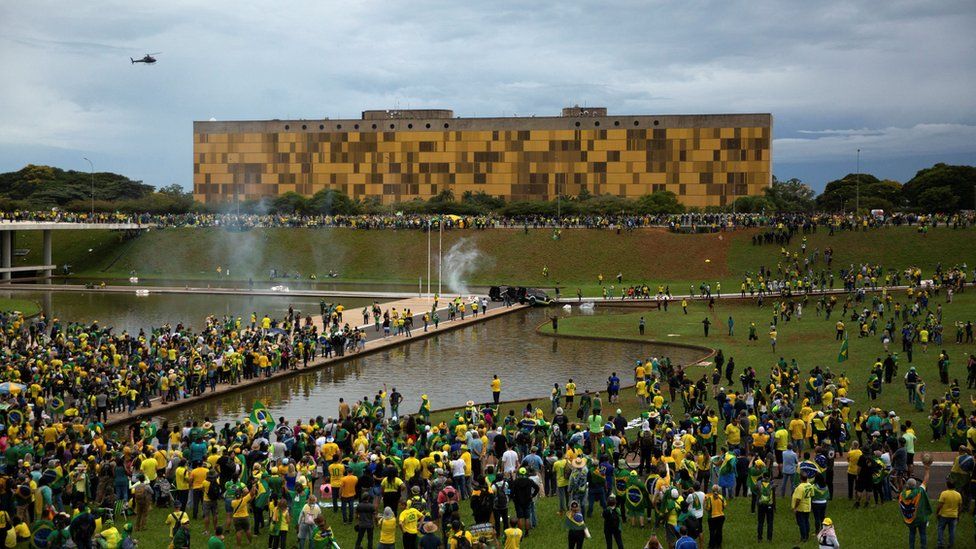
Social media’s role in the riots is under scrutiny.
Since Elon Musk took over, Twitter has laid off staff including those in Brazil whose role was to tackle misinformation around the election. Twitter and Musk have repeatedly said they are addressing the most harmful content on the site.
It’s not the first time that misinformation online has fuelled a physical assault on democracy. The former Chief Executive of Twitter, Jack Dorsey, admitted to a hearing into the storming of the U.S. Capitol in 2021, that misinformation on social sites played a role in inciting the violence.
Meta, which owns Facebook, and Google, YouTube’s parent company have said they are removing content that praises or supports anti-democratic demonstrators in Brazil.